
Collections
 Free Shipping
 Made In USA
LionSteel has built knives in Maniago, Italy, the country's centuries-old city of blades, since Gino Pauletta founded the company with his wife Cesarina in 1969. The name honors a stone lion carved by Gino's own grandfather, and today his sons Daniele, Gianni, and Massimo run the operation that transformed from traditional hunting knives into the most decorated innovator in modern production cutlery. Gianni also leads the MKM consortium uniting Maniago's great makers, but the awards shelf belongs to LionSteel alone.
From 2014 through 2017, a LionSteel-built knife won Blade Show Overall Knife of the Year every single year: the CRKT Hi Jinx they manufactured, then the T.R.E. Titanio, the Kur, and the SR-11. The 2014 Manufacturing Quality Award for the TiDust ended Chris Reeve Knives' ten-year hold on that title, and the TiDust itself made history as the first production knife built by DMLS, fusing titanium powder layer by layer into a skeletonized handle no milling machine could cut.
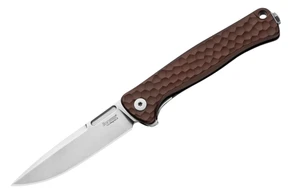
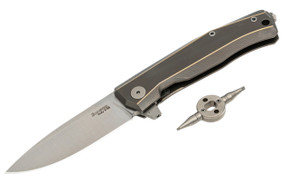
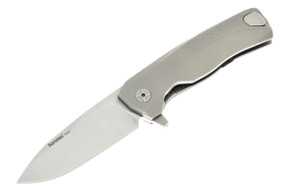
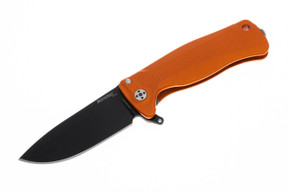
The SR-1 started it all in 2010: the first production folder with a handle machined from a single billet, no scales, no fasteners, winning Most Innovative Imported Design and founding the SOLID line that the industry has chased ever since. The current SR22 carries that integral construction forward at EDC size, and the ROK adds the RotoBlock safety and a hideable clip to the monolithic formula. The Myto, a Molletta design in aerospace aluminum and M390, shows how light the philosophy can run.
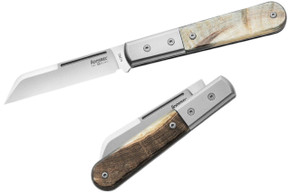
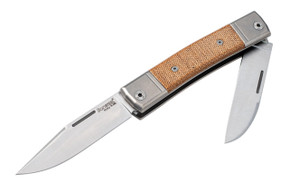
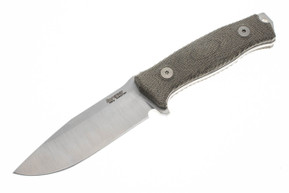
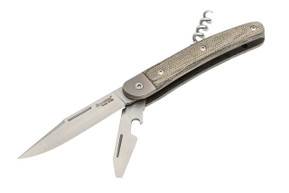
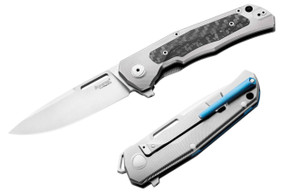
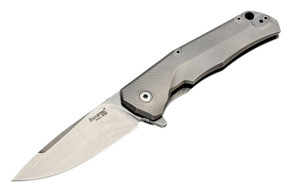
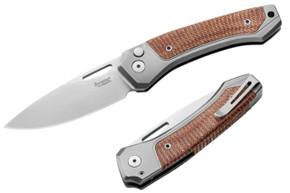
The T.R.E., or Three Rapid Exchange, was the first user-modifiable flipper, letting you swap between flipper tab, thumb studs, or both. The traditional wing runs deep: the Jack series slipjoints pair M390 with titanium bolsters and wood or micarta covers, the Barlow line brings modern materials to a pattern whose whole history is told in our traditional pocket knife patterns guide, and the bestMan, Emmet, Twain, and Q4TTRO round out a modern traditional catalog nobody in Europe matches, all part of our broader traditional knives collection. On the fixed side, the LionSteel fixed blades run from M390 hunters like the Acha to Sleipner-bladed field knives.
Böhler M390 at 59-61 HRC anchors the catalog, with CPM MagnaCut appearing across recent releases and Sleipner tool steel holding down hard-use fixed blades, all covered in our knife steel guide. Handles span integral titanium and aluminum, carbon fiber, canvas micarta, and olive wood, detailed in our knife handle materials guide. Everything is machined in Maniago under the family's eye, which is why fit and finish at this price point keeps embarrassing knives that cost twice as much.
 Free Shipping Made In USA