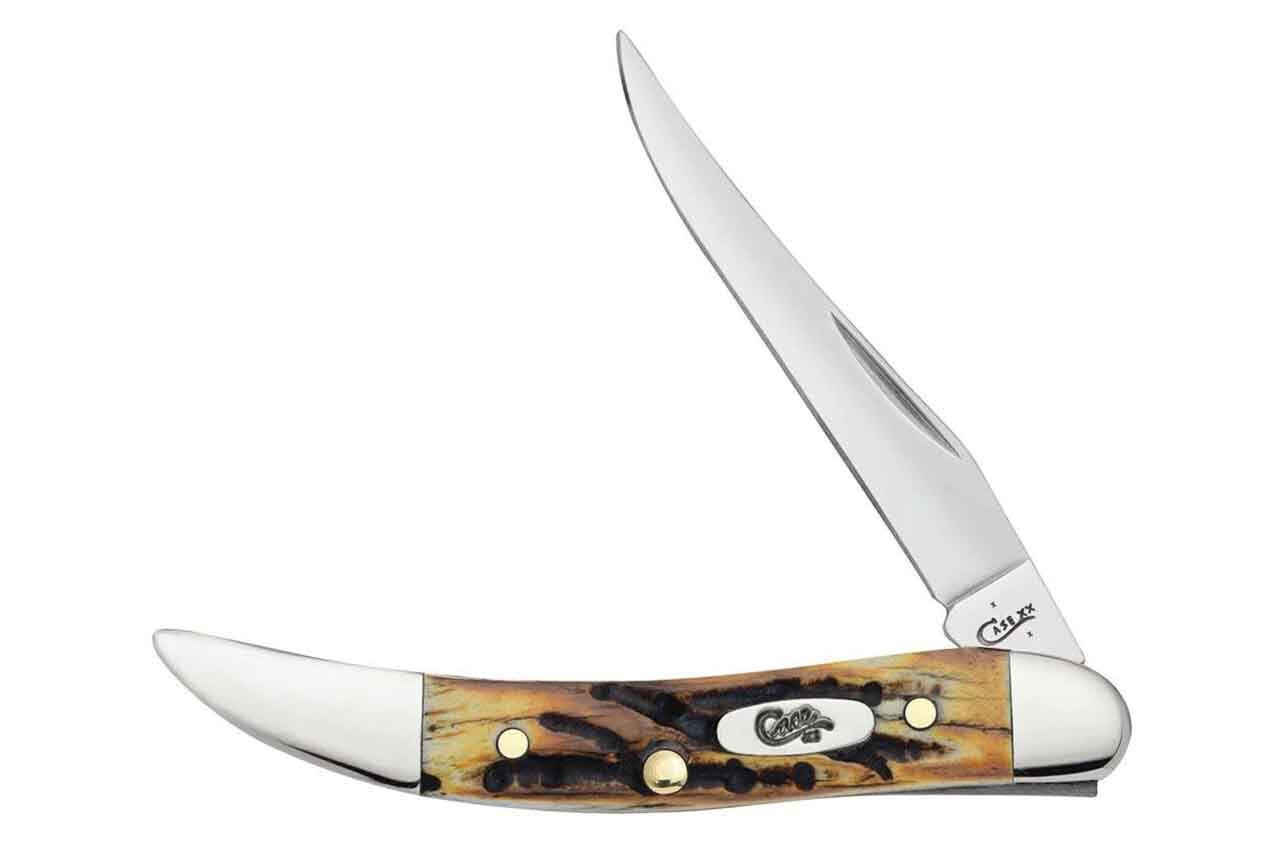
The Texas toothpick knife traces its lineage to the Spanish navaja—those long, slender clasp knives that defined southern European cutlery for centuries. When Spanish and French influence spread through Louisiana, Mississippi, and Texas, the navaja's descendants came with it. American cutlers began producing their own versions in the 1890s after tariff acts made domestic production competitive with imports. Case started manufacturing toothpicks sometime prior to 1915. The pattern earned various regional names over the decades: tickler, switch knife, fish knife, and eventually Texas Toothpick. The "Texas" designation stuck because the pattern became synonymous with the American South, where its elegant profile and sharp point made it the pocket knife of choice for generations of farmers, fishermen, and working men who valued a blade that could handle precise cuts without unnecessary bulk.
What makes the toothpick blade so distinctive?
The long clip blade—sometimes called a California clip—defines the pattern. Unlike the belly-forward curves of most pocket knife blades, the toothpick runs narrow and straight before tapering to a fine point. This geometry excels at detail work: piercing, scoring, trimming, and precision slicing. The blade reaches approximately 2¼" on the Small Texas Toothpick (3" closed) and stretches considerably longer on the Medium version (4¼" closed). That slim profile also made the toothpick popular as a fish knife—the blade shape works naturally for filleting small catches, and two-blade versions historically included a secondary blade with hook disgorger and scaler built in. Whether you're opening packages, cleaning game, or handling delicate cutting tasks, the toothpick blade geometry rewards precision over power.
How does the serpentine handle disappear in your pocket?
The handle tapers elegantly at both ends with a gentle upward arc through the center—what knife collectors call a clasp-style frame. This serpentine shape hugs the natural curve of your palm during cutting while eliminating the bulk and squared edges that make other knives print through fabric. The Texas Toothpick earned its reputation as the knife you forget you're carrying until you need it. Nickel silver bolsters cap each end, protecting handle scales while adding enough weight for balanced handling. The single backspring holds the blade firmly open without a lock mechanism—traditional slip-joint construction that's served working hands for over a century.
Which Texas Toothpick size fits your carry?
Case currently produces the pattern in two primary sizes. The Small Texas Toothpick (pattern 0096) measures 3" closed with a blade just over 2" long—compact enough for dress pants, light enough at under an ounce for all-day carry. The Medium Texas Toothpick (pattern 0094) stretches to 4¼" closed with proportionally more blade length, providing a more substantial cutting tool while maintaining the pattern's slim profile. Historically, Case produced even larger versions—the 5" pattern 093 and 5½" pattern 098—that collectors still pursue on the secondary market. Handle materials span the full Case catalog: Yellow Synthetic for affordable durability, jigged bone in various colors and textures, Genuine Stag for premium carry, and modern options like Kirinite for distinctive appearance.
 Free Shipping
 Made In USA