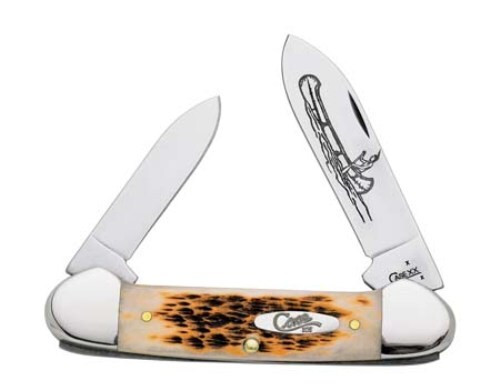
The name tells you everything. Those curved, raised bolsters at each end give the handle a profile that looks exactly like a canoe's hull—symmetrical, smooth, and unmistakable from across a room. Case began producing the pattern 131 sometime prior to 1915, making it one of their oldest continuous designs. The Canoe emerged during the golden age of American cutlery when Case, their rival Case Brothers, and Union Cutlery (later Ka-Bar) were establishing the patterns that would define traditional American pocket knives. While the Trapper and Stockman found favor with workers who needed function first, the Canoe attracted buyers who wanted equal parts aesthetics and utility. That balanced, symmetrical silhouette became Case's canvas for showcasing handle materials—bone, stag, pearl, and synthetics all look particularly striking on this frame.
What makes the Canoe design so friendly?
Those distinctive bolsters aren't just decorative. They completely cover the blade tangs when closed, eliminating the sharp edges that can snag pocket linings and wear through fabric. The smooth, rounded profile slips in and out of a pocket without catching. At 3⅝" closed, the standard Canoe (pattern 131) carries comfortably without bulk. The equal-end design means no wrong way to grab it—reach into your pocket and the knife orients naturally in your hand. Gentlemen's knife enthusiasts and collectors who actually carry their knives appreciate this practical elegance.
How do the two Canoe blades work together?
The standard Canoe pairs a spear point master blade with a smaller pen blade opening from opposite ends. The spear point handles general cutting—its centered point and symmetrical edges work equally well for push cuts and draw cuts. The pen blade takes over for detail work where a smaller profile offers better control. Both blades share a single backspring, keeping the knife slim. Some three-blade Canoe variations add a punch blade, placing them in the cattleman's knife category. The larger Gunboat Canoe (pattern 94) stretches to 4¼" and carries three blades—spear, sheepfoot, and spey—for users wanting more cutting options in the Canoe frame.
 Free Shipping
 Made In USA