 Free Shipping
 Made In USA

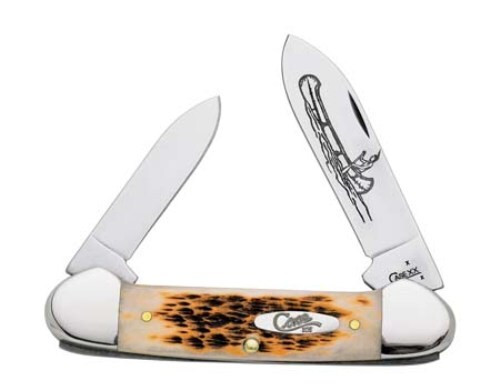
The Case Canoe, pattern 131, takes its name from its curved, raised bolsters at each end, which give the handle the symmetrical profile of a canoe's hull. Early on, the pattern was made mostly by Case, its arch rival Case Brothers, and Union Cutlery, the company that became KA-BAR. After World War II, Case was the only maker to keep the two blade Canoe in its line, and it remains a showcase pattern among Case knives.
The rounded bolsters cover the blade tangs when closed, so there are no sharp corners to snag a pocket lining, and the smooth profile slips in and out without catching. At 3.625 inches closed, the standard Canoe carries without bulk, and its equal end shape means it orients naturally in your hand however you grab it. While the Case Trapper and Case Stockman lean toward work, the Canoe balances looks and utility.
The standard Canoe pairs a spear point master blade with a smaller pen blade, opening from opposite ends. The spear's centered point and broad, thin grind make it an excellent slicer for push and draw cuts, while the pen takes over detail work. Current builds run Tru-Sharp stainless, Case's name for 420HC, with Chrome Vanadium on select releases for users who want a carbon steel patina. Our comparison of every major knife steel covers both.
The Big Gunboat Canoe, pattern 94, stretches the frame to 4.25 inches closed with three blades: spear, sheepfoot, and spey. Collectors also prize the Canoe's history. Case offered it only in genuine stag until 1964, when a pilot run in bone appeared, and the etched Indian in the canoe blade arrived in 1974.
That balanced shape is a perfect canvas for handle materials, and our current Canoes wear smooth chestnut and amber bone, including a version in a gift tin. Our guide to knife handle materials explains how bone wears. For an even smaller gentleman's knife, see the Case Peanut, and engraved Case knives add a name to make it a lasting gift.
Free Shipping Made In USA