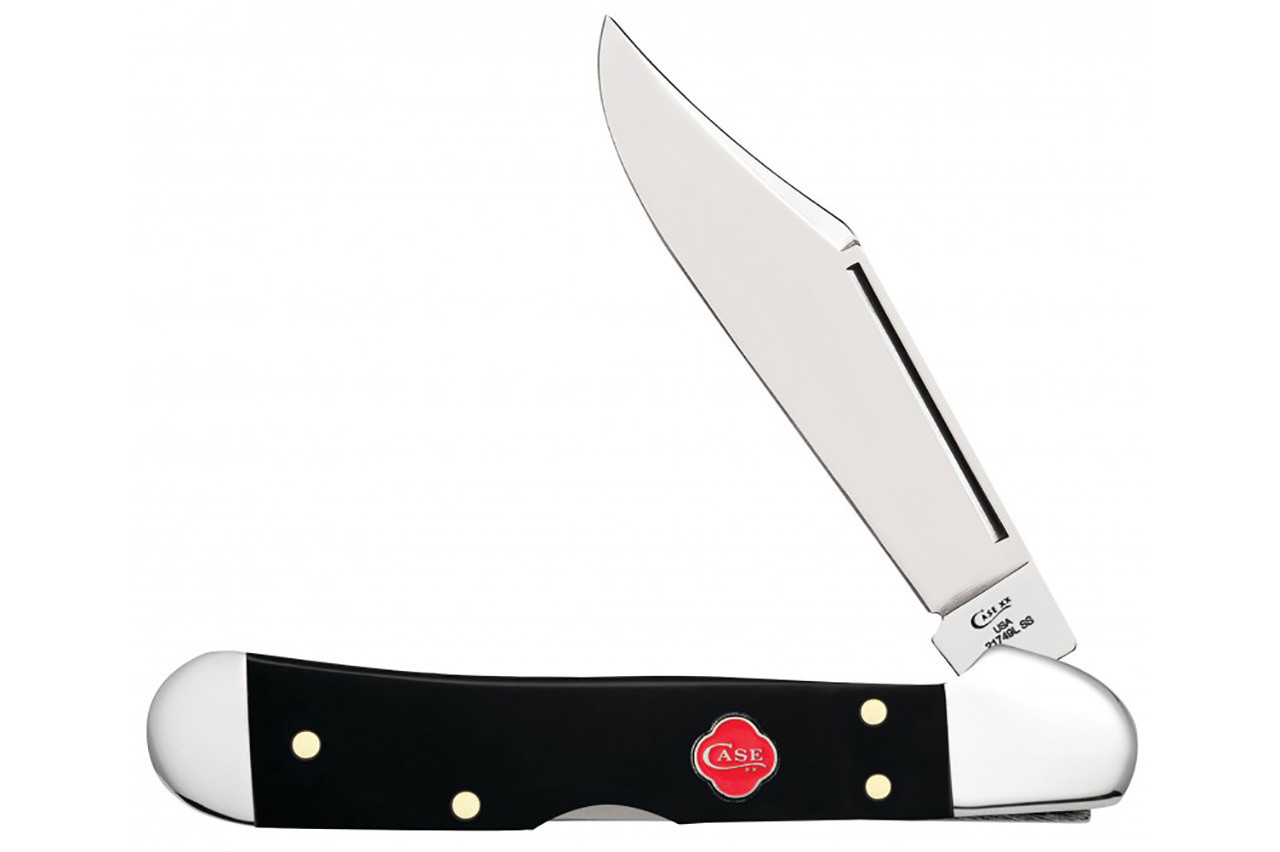
In 1997, Case introduced an entirely new pattern that the collector world hadn't seen before. Designed by Case legend Tom Hart at the request of sales manager Dick Kearney, the Copperlock started as a concept for a "single-bladed lock Trapper." Hart designed flat blades with a long nail nick and cut swedge, and together with Kearney, they determined where to place the lock mechanism. Early samples showed the blade tang extending above the bolster, which threatened to snag in pockets. The solution: add the distinctive humped bolster from the Copperhead pattern. That design change gave the knife both its name and its signature look. Case historian Shirley Boser assigned the pattern number 549—a deliberate combination of 54 (Trapper) and 49 (Copperhead)—to reflect the knife's hybrid heritage.
What makes the lockback mechanism different from slip-joint patterns?
The Copperlock uses a back-lock design that physically secures the blade in the open position. Unlike traditional slip-joints where spring pressure alone holds the blade, the Copperlock's lock bar engages a notch in the blade tang to prevent closure until you deliberately release it. The lock release sits mid-spine, allowing a secure grip during use while minimizing accidental disengagement. This matters for piercing tasks and heavy cutting where slip-joint blades might "walk and talk"—the collector's term for unexpected blade movement. The Copperlock delivers the security of a lockback within a frame that looks and carries like a traditional gentleman's folder.
How do the two Copperlock sizes compare?
Case produces the Copperlock in two sizes. The standard Copperlock (pattern 549) measures 4¼" closed with a blade approximately 3½" long—substantial enough for working tasks while maintaining pocket-friendly proportions. The Mini Copperlock (pattern 749) drops to 3⅝" closed with a blade around 2¾" long, offering the same lockback security in a more discrete package. The Mini debuted in 1998, following the original's 1997 introduction. Both sizes feature the same single bolster at the pivot end—the Copperhead-style hump that protects the blade tang corner when closed and gives the pattern its distinctive tapered profile.
Why has the Copperlock become a collector favorite?
Case released the Copperlock with traditional jigged bone handles in Old Red with Rogers jig, establishing the pattern's identity from day one. Since then, the pattern has appeared in virtually every handle material Case offers—from classic Amber Bone and Yellow Synthetic through exotic materials like genuine stag, abalone, and mammoth ivory. The clip blade with its cut swedge takes on different character with each handle choice. Case celebrated the Copperlock's 10th anniversary in 2007, then retired the pattern to the Case XX Vault in July 2008. The pattern has since returned to regular production, proving its staying power with both collectors who appreciate the clean lines and users who want lockback security without sacrificing traditional aesthetics.
 Free Shipping
 Made In USA