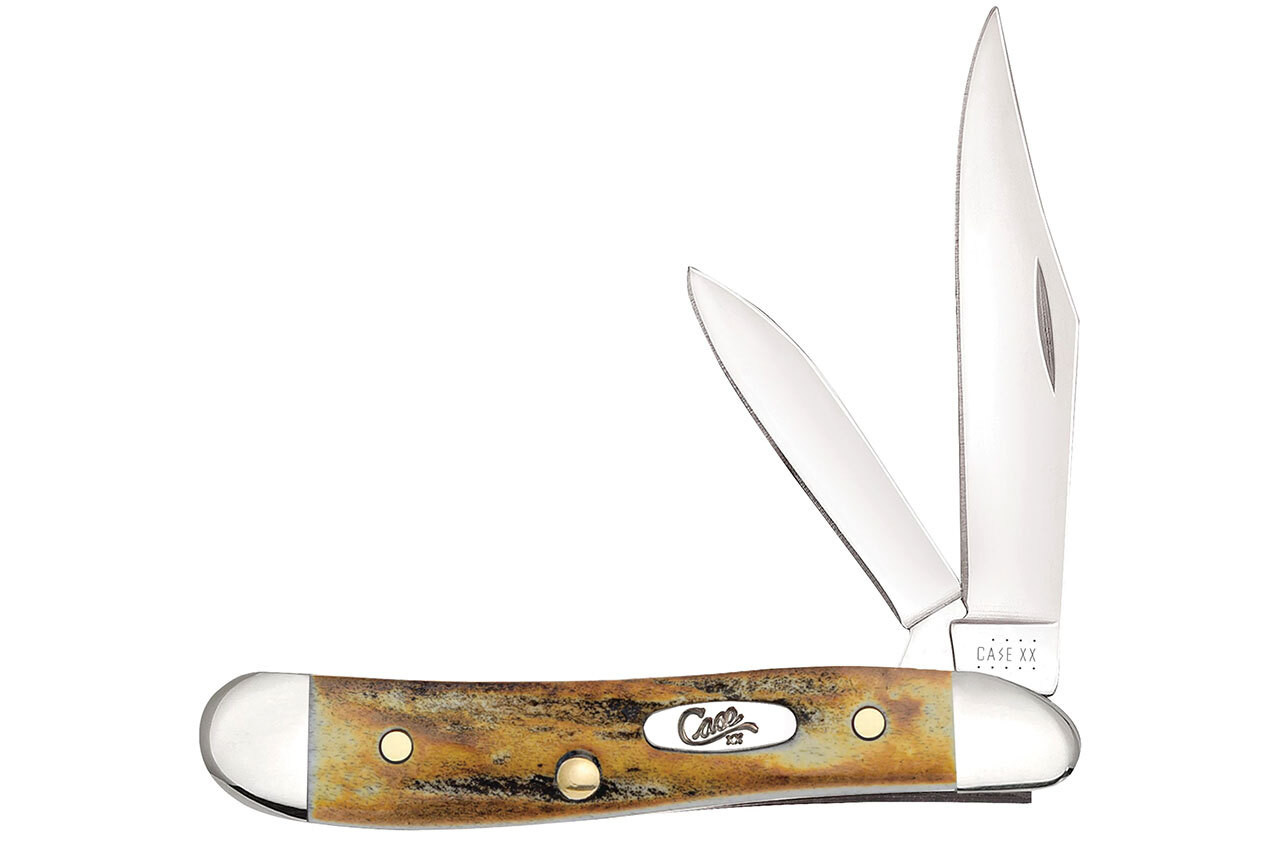
Case introduced the Peanut knife (pattern 20) sometime before 1915, and collectors immediately understood the name—the small serpentine handle resembles the legume almost perfectly. At roughly 2⅞" closed and barely over an ounce, the Peanut was designed for the watch pocket era when men wanted a capable blade without bulk. That compact philosophy still resonates. The Peanut slips into dress slacks, disappears in a coin pocket, and carries so light you forget it's there until you need it. Case has produced the pattern continuously for over a century because the demand never stopped. When you need a knife but don't want to carry a knife, the Peanut solves the problem.
How do two blades fit in such a small frame?
The Peanut's engineering puts both blades on a single backspring at one end of the handle, keeping the opposite end clean and slim. The clip blade runs approximately 2.1" and handles general cutting—the curved belly slices while the point handles detail work. The pen blade drops to around 1.5" for lighter tasks like opening mail, trimming threads, or cleaning fingernails. Having both blades hinge from the same end means the Peanut carries thinner than double-ended patterns of similar length. Some variations swap the pen blade for a spey (called a Trapper Nut) or even miniature scissors. Older Peanuts sometimes featured spear master blades rather than clips, and versions with three or more blades earned the nickname "Big Nut."
What makes the Peanut a gentleman's knife?
The Peanut belongs to the gentleman's knife tradition—compact tools meant for civilized tasks rather than heavy work. The serpentine frame with rounded ends feels refined in the hand. The small size allows discrete carry in professional settings where larger knives might raise eyebrows. Opening packages, cutting loose threads, slicing an apple at lunch—the Peanut handles everyday tasks without announcing itself. Case produces the pattern in handle materials ranging from classic Yellow Synthetic for working use to Genuine Stag and exotic bone jigging patterns for dress carry. The nickel silver bolsters and brass liners add quality weight to the compact package.
Which Peanut handles attract collectors?
Case has released the Peanut in virtually every handle material they've ever offered. Yellow Synthetic (Delrin) represents the working classic—affordable, durable, and instantly recognizable. Amber Bone with Peach Seed jigging delivers traditional elegance. Genuine Stag commands premium prices for its natural character. Vintage Peanuts from the Tested era (1920-1940) in green bone, Rogers bone, or cracked ice celluloid attract serious collector attention. Some older versions featured long pulls or saber-ground master blades—characteristics that increase value significantly. The pattern's longevity means collectors can pursue production variations spanning a full century of Case manufacturing history.
 Free Shipping
 Made In USA