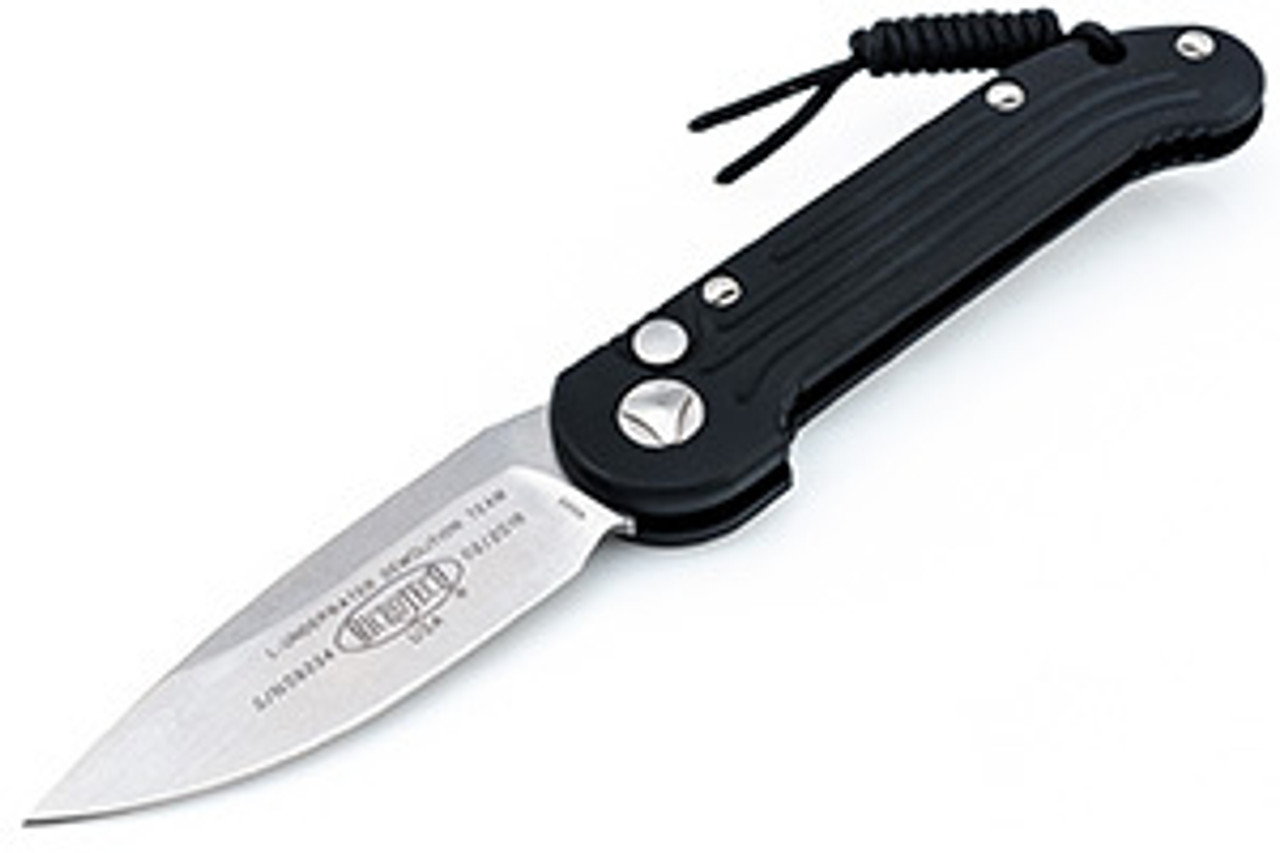
What does LUDT stand for, and what is the history behind this knife?
LUDT stands for Large Underwater Demolition Team, honoring the elite Navy frogmen who later became the first Navy SEALs. The knife traces its lineage back over twenty years to Anthony Marfione's original UDT design, Microtech's first knife, which helped establish the company in the mid-1990s. The UDT was engineered with a powerful deployment action capable of firing the blade underwater, and the LUDT maintains this capability while adding modern upgrades. The Large UDT followed the compact original, offering a more substantial cutting tool while retaining the proven deployment mechanism that made the UDT popular among knife enthusiasts. The knife has undergone many refinements, with the current Gen III representing the most advanced evolution of this foundational Microtech design.
What are the specifications and blade options for the Microtech LUDT?
The LUDT features a 3.5-inch blade, an overall length of 8 inches when deployed, and a handle length of 4.5 inches when closed, weighing about 3.6 ounces. The handle is precision-machined from lightweight 6061-T6 aluminum with a hard anodized finish and grooved contours for better grip. The LUDT offers a variety of blade configurations, including drop point and tanto profiles, with options for plain, partially serrated, or fully serrated edges. Blade finishes range from stonewash to apocalyptic, with the apocalyptic finish adding durability and a distinctive tactical look. The knife comes in many anodized aluminum handle colors, letting users choose a combination that matches their preferences while maintaining Microtech's professional-grade construction.
What steel does the Microtech LUDT use, and how has it evolved?
Earlier LUDT models featured Bohler Elmax steel, a European powder metal known for exceptional edge retention and high chromium content for superior corrosion resistance. More recent pre-Gen III models used CTS-204P steel, which offers outstanding wear resistance and edge-holding comparable to other high-end blade steels. The Gen III LUDT is the first Microtech push-button knife to feature Bohler M390MK, a proprietary steel developed exclusively for Microtech with Bohler engineers. Microtech worked with Bohler to modify standard M390 for better edge retention, corrosion resistance, and improved manufacturing. This progression shows Microtech's commitment to premium blade materials, with each steel offering excellent performance. M390MK is the current pinnacle of their metallurgical specifications.
What improvements does the Gen III LUDT offer over previous versions?
The Gen III LUDT introduces a pivot system with 24 silica carbide bearings, delivering the smoothest deployment in the LUDT's history. The knife features 3M grip inlays on the handle for optimal traction, ensuring stability even in wet or demanding conditions. Microtech uses standard Torx hardware throughout Gen III, making maintenance easier than with previous proprietary fasteners. Design refinements include a fuller groove along the blade, a crowned spine with jimping on the thumb ramp for better control, and a reinforced tip for improved penetration. Additional features include a milled titanium backspacer and a refined actuation button design. These upgrades make Gen III the most refined LUDT yet while maintaining the core characteristics that have made this design successful for over two decades.
How does the LUDT compare to the Microtech Ultratech?
The fundamental difference between these knives is their deployment mechanism: the LUDT is a side-opening design where the blade swings out laterally, while the Ultratech is an out-the-front design where the blade extends directly forward from the handle tip. The Ultratech features dual-action functionality, meaning both opening and closing occur via the slide switch, whereas the LUDT requires manual pressure to overcome the spring when closing. The LUDT offers superior blade geometry for slicing tasks, with a more gradual edge angle that excels when the entire blade travels through material, while the Ultratech's narrower blade results from the complex spring and linkage systems required for OTF operation. The Ultratech measures 3.125 inches in blade length and weighs 3.45 ounces with a blade thickness of 0.13 inches, making it slightly more compact than the LUDT. Both knives share similar premium steel options and aluminum construction, with the choice between them often coming down to user preference for deployment style and intended cutting tasks rather than quality differences.
Is the Microtech LUDT durable enough for hard use?
The LUDT was engineered as a true utility tool without compromising build quality, featuring a deployment force strong enough to reliably open while underwater, which is not something most push-button knives can accomplish. The handle construction uses precision-machined 6061-T6 aluminum, an aerospace-grade material combining exceptional strength with lightweight characteristics, and the knife is designed to be water-resistant for use in demanding environments. The Gen III incorporates the robust 24 silica carbide bearing system that enhances both the smoothness and durability of the deployment action, ensuring consistent performance over extended use. Microtech designed this knife to maintain the ruggedness needed for demanding conditions while incorporating modern upgrades that improve performance without sacrificing reliability. Users should note that while the LUDT excels at general cutting tasks and can handle substantial daily use, the high-hardness premium steels prioritize edge retention over maximum impact toughness, making the knife better suited for cutting applications rather than heavy prying or extreme abuse.
Who is the Microtech LUDT designed for, and what makes it ideal for everyday carry?
The LUDT bridges tactical functionality and practical everyday carry, making it ideal for enthusiasts who appreciate refined engineering without excess bulk. At 3.6 ounces with a slim profile, the knife carries comfortably in the pocket all day without the fatigue of heavier tactical folders. The 3.5-inch blade is ideal for EDC tasks, providing enough cutting edge for food prep, package opening, and general utility work while staying manageable for precise cuts. Law enforcement, military personnel, and first responders have favored the LUDT for its reliability and rapid single-handed deployment, but it is also popular among civilians who value premium construction and proven performance. The side-opening design is advantageous in office and professional settings where discretion matters, as deployment can be more subtle than with OTF mechanisms. Collectors appreciate the LUDT's historical significance as Microtech's foundational design, while working users value the premium materials, American manufacturing, and field-tested durability that justify investing in a knife built to last decades.