 Free Shipping
 Made In USA

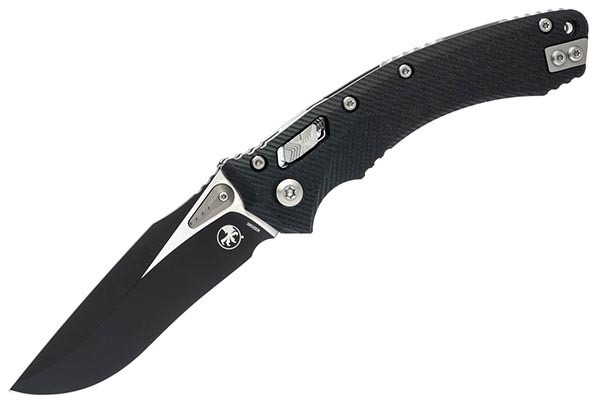
Microtech manual folding knives are the newest chapter in the catalog, and the most surprising one: a company that built its name on springs proving it can build knives without them. The manual side has grown from an experiment into a full family in just a few years, and the machining standard came along unchanged from the Microtech lineup you already know.
The center of gravity is the RAM-LOK, and understanding it explains most of this page.
RAM-LOK is Microtech's crossbar lock, built around a solid steel billet driven by a single coiled spring instead of the omega springs most crossbar designs live and die by, with X-shaped buttons on both flanks for a finger-safe, fully ambidextrous close. The MSI is the workhorse of the family, a sheepsfoot-bladed daily knife from polymer up through titanium; the Amphibian and its Mini answer with a drop point in machined aluminum, G-10, and Marfione Select titanium; and the Anax stands apart as the titanium frame lock, the dress folder of the brand.
The heritage names crossed over too. The SOCOM Elite still anchors the classic manual side with its 4-inch clip point and tanto, now joined by SOCOM and Delta Ram-Lok versions and Signature runs like the Warcom. The Borka-designed Stitch and Mini Stitch Ram-Lok bring the catalog's boldest silhouette to a bar lock, and even the LUDT, descendant of the first knife Microtech ever made, now folds manually in Ram-Lok form. Nothing else in American production lets you carry this much brand history without a spring.
Blades across the manual family run Bohler M390MK, the tuned M390 produced exclusively for Microtech, and our comparison of every major knife steel shows why it anchors the program. Choosing comes down to deployment feel and dress code: thumb hole or thumb studs, workwear polymer or machined titanium, sheepsfoot utility or drop point reach. Whichever way you go, the bar drops the same satisfying way, and that is half the reason these rarely stay in stock.
Free Shipping Made In USA