 Free Shipping
 Made In USA

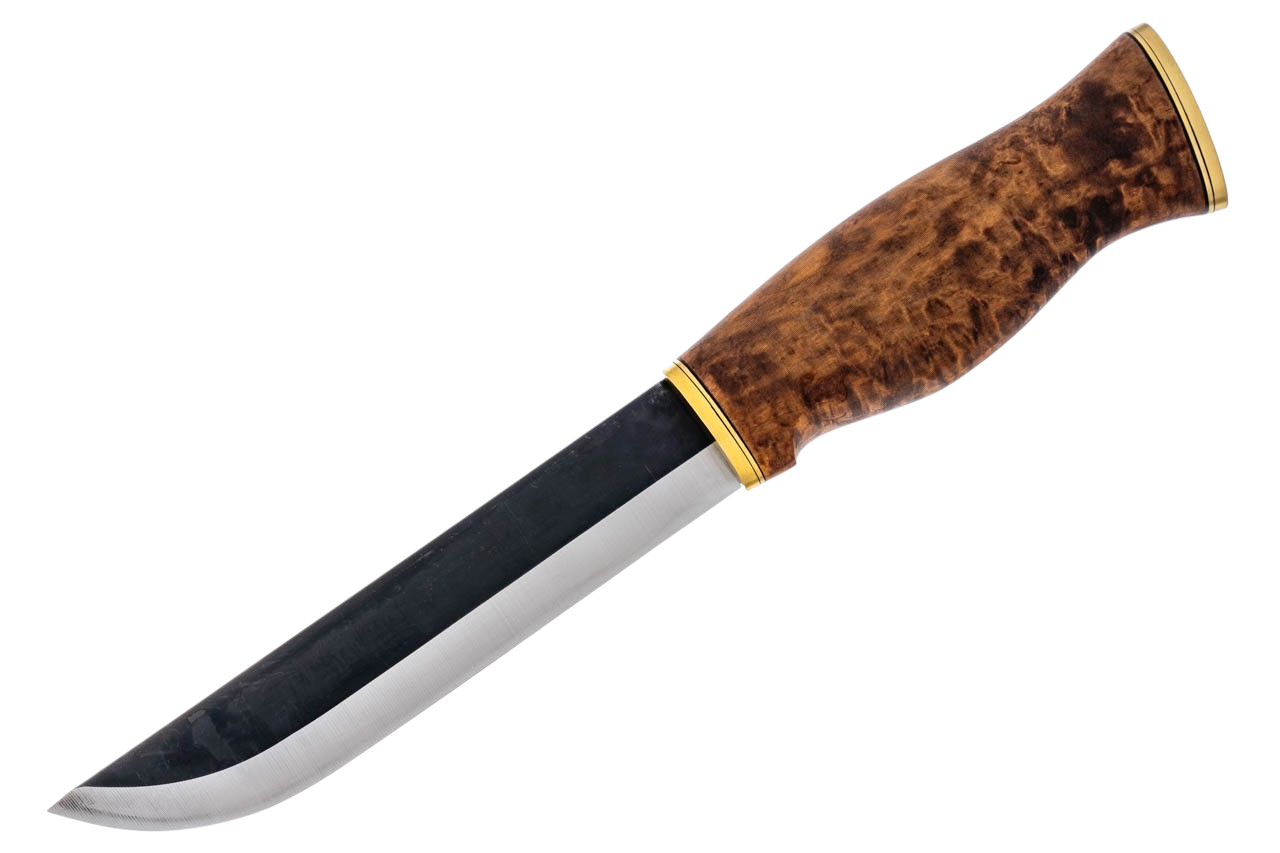
The puukko is Finland's national knife: a short, guardless fixed blade with a hidden stick tang, a flat spine, and an edge that handles everything from carving kindling to dressing grouse. This collection gathers true Finnish puukko knives from Lappi and Kauhava, modern Finnish builds from Brisa, Norwegian laminated blades from Helle, and American scandi patterns from TOPS that run the same geometry in modern steels. If a knife earns its keep on wood, game, and camp chores rather than a display shelf, it belongs here.
A traditional puukko runs a blade of three to four inches, birch or antler over a buried tang, no guard, and a deep pouch sheath that swallows half the handle. The pattern has covered Finnish daily life for centuries because it refuses to specialize: it carves, it slices, it cleans fish, it preps dinner. The Kauhava puukkos here come from the town whose name is practically synonymous with Finnish knife making, Lappi builds working puukkos and fillet patterns in the same tradition, and Brisa's Necker series shrinks the geometry down to neck-carry size. More Nordic steel lives on our Marttiini and Morakniv pages, where Rovaniemi's oldest knife factory and its Swedish cousin carry the tradition at production scale.
The leuku is the puukko's big brother from Lapland, the Sami herdsman's blade built for the work a short knife shouldn't do: splitting kindling, breaking down big game, and chopping through frozen wood. Traditional kit in the far north pairs the two, leuku for the heavy strokes and puukko for the fine ones. The Lappi Leuku 145 here keeps the classic proportions, with a broad carbon steel blade and enough handle to swing.
Nearly everything in this collection wears a scandi grind, the single flat bevel that runs from mid-blade to a zero or near-zero edge. It is the grind that made Nordic blades the default choice for bushcraft knives: the bevel registers flat against wood, so feather sticks, notches, and tent stakes come off the blade with a control hollow grinds can't match. Steel choices split along tradition too, with high carbon from the Finnish makers and TOPS 1095 for easy field sharpening, and triple-laminated stainless from Helle for wet weather. Our knife steel comparison guide breaks down how each behaves at the sharpening stone.
Free Shipping Made In USA