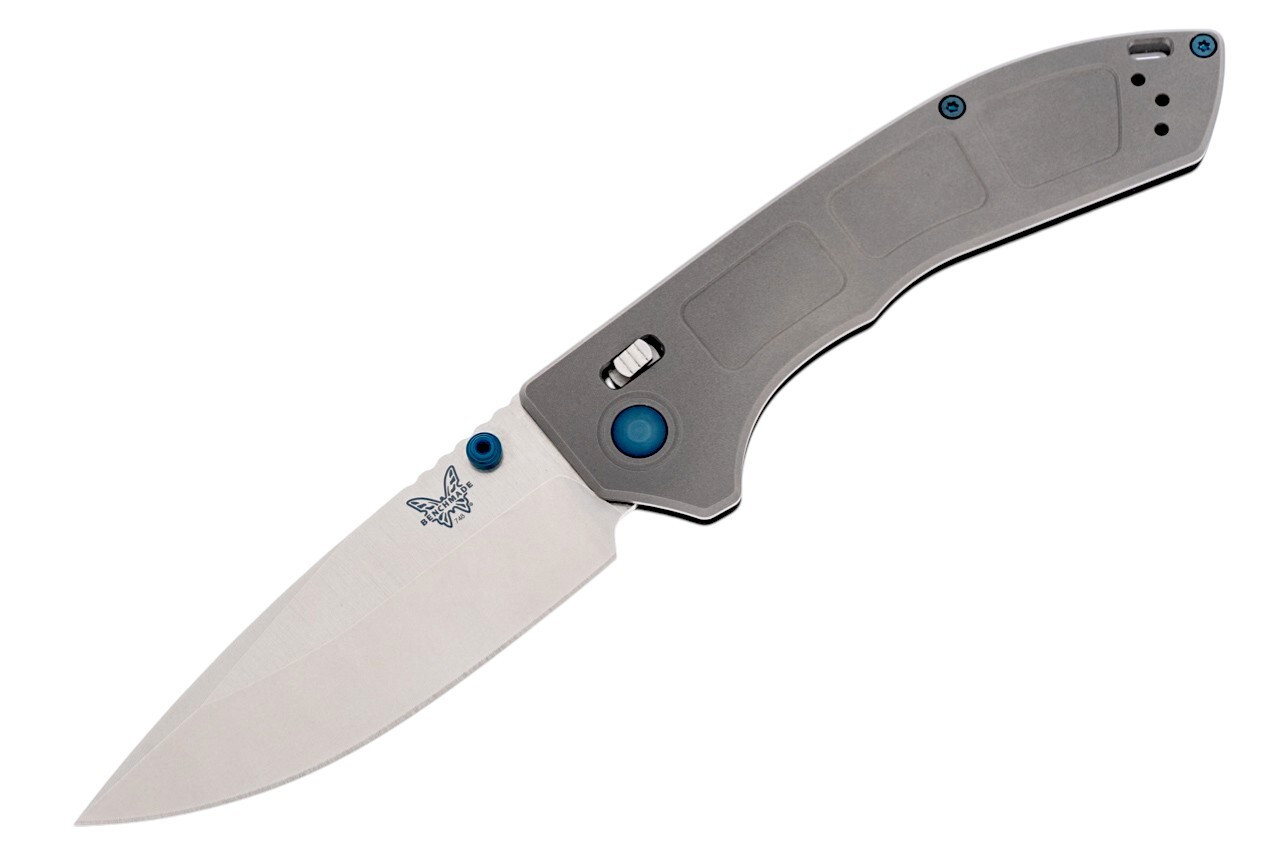
The Benchmade Narrows is the result of a specific engineering question: how thin can a full-size, structurally sound titanium folder actually get? The answer is 0.28 inches — a handle thickness that makes the 748 Narrows the slimmest full-frame folder Benchmade has ever produced, and 33% thinner than the Bugout, which was itself already a benchmark for lightweight carry. What makes that number meaningful is not just the profile dimension, but everything Benchmade had to solve structurally to achieve it without sacrificing the lockup integrity that defines their reputation.
The Engineering Problem With Thin
Conventional AXIS lock architecture relies on steel liners running the full length of the handle on both sides, with Omega springs — paired U-shaped wire springs — providing the tension that keeps the crossbar engaged against the blade tang. That system is proven and robust, but it has a floor in terms of handle thickness; the liners and spring geometry require space that simply cannot be compressed below a certain point without compromising function.
For the Narrows, Benchmade redesigned the lock mechanism from the ground up. The steel liners and Omega springs are gone entirely, replaced by a torsion spring and lock stud assembly that achieves the same ambidextrous crossbar locking function in a fraction of the space. The handle becomes a single structural unit — two milled titanium scales with no liner sandwich — which is where the 0.28" dimension becomes achievable. The result retains the full ambidextrous operation and positive lockup characteristic of the AXIS system while fitting inside a handle profile that no liner-based construction could occupy. The AXIS bar itself is directionally textured for grip and stays low-profile against the handle during carry.
The Titanium Frame
Both the 748 full-size and the 743 Mini Narrows use 6Al-4V titanium — the aerospace-grade alloy containing 6% aluminum and 4% vanadium that is the industry standard for structural titanium applications where high strength-to-weight ratio is the primary requirement. It is significantly stronger than commercially pure titanium, substantially lighter than steel, and corrosion-resistant in any carry environment. The handle scales are fully milled rather than cast or stamped, with three rectangular fullers providing both grip texture and material reduction. Despite the liner-less construction, Benchmade reports the Narrows achieves up to twice the breaking force of the Bugout — a function of titanium’s inherent rigidity versus the polymer frame of that knife.
The open-back construction means neither scale has internal metal reinforcement, which is how the weight figure of 2.41 oz. on the full-size 748 is achievable with a 3.43" blade — a combination that is genuinely rare in full-frame folders. The 743 Mini brings that down to 1.98 oz. with a 2.98" blade, making it one of the lightest titanium-handled folders in production at any blade length.
Blade Steel: M390 and 20CV
The 748 runs Böhler M390 — an Austrian-developed third-generation powder metallurgy stainless, originally engineered for plastic injection mold tooling and later adopted by the knife industry for its exceptional combination of edge retention, corrosion resistance, and workability. M390 achieves hardness in the 58-61HRC range with a fine, uniform carbide structure that produces excellent cutting performance and holds an edge well beyond what conventional stainless grades deliver. Blade stock on both the 748 and 743 is 0.08 inches — a deliberately thin grind that maximizes slicing performance in a blade profile that is, by design, not built for prying or lateral stress.
The 743 Mini uses CPM-20CV — the American Crucible Industries equivalent of M390, produced via Crucible’s own powder metallurgy process. The two steels are chemically near-identical, sharing the same high chromium and vanadium content that drives their performance characteristics. The difference between them in practical use is marginal and largely a function of heat treatment rather than composition. Benchmade has noted that they consider their M390 marginally tougher and their 20CV to offer slightly better edge retention — both a reflection of their own heat treatment protocols rather than a fundamental material distinction.
Hardware and Finish
Across the lineup, Sapphire Blue PVD coated hardware — thumb studs, pivot hardware, and mini deep-carry pocket clip — provides both a distinctive aesthetic identity and a durable coating that resists wear and corrosion. The black titanium variants (748BK-01 and 743BK-01) extend the DLC coating across the blade in addition to the hardware, producing a fully blacked-out build on the same titanium frame. The mini deep-carry clip indexes the knife tip-up and keeps the profile below the pocket line, consistent with the overall design goal of maximizing concealability without sacrificing accessibility.
 Free Shipping
 Made In USA