
Collections
 Free Shipping
 Made In USA
Cold Steel has built its catalog around locks and blade geometry that survive abuse, and around forty years of putting that claim on video rather than in a spec sheet. Lynn Thompson founded the company in 1980 and sold it to GSM Outdoors in 2020, and the proof-testing culture survived the sale. Our Cold Steel brand history covers how the demonstrations became the marketing.
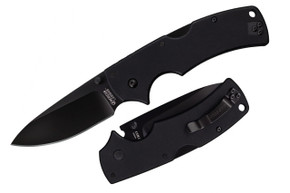
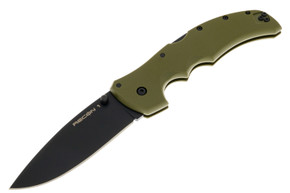
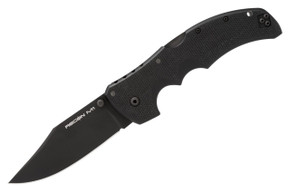
The Tri-Ad lock, developed with custom maker Andrew Demko, is a modified lockback with a stop pin between the tang and the lock bar. That pin absorbs shock that would otherwise drive straight into the lock face, which is why the mechanism holds up under the spine-whack testing Cold Steel built its reputation on. It runs on the Recon 1, American Lawman, and AD-10. The AD-15 uses Demko's Scorpion Lock instead, a spring-loaded hybrid that opens and closes ambidextrously without putting fingers in the blade path.
Core production moved off AUS-8A years ago, with CTS-XHP and CPM S35VN carrying the upgraded folders and AUS-10A covering the mid tier. San Mai is the one worth understanding before you buy. It is a three layer laminate with a harder stainless core, VG-1 on current production and AUS-8 on older examples, bonded between softer stainless outer layers. The soft outer layers take impact and lateral stress while the core holds the edge. It is not a carbon and stainless laminate, and it is not the same construction as the older Carbon V blades.
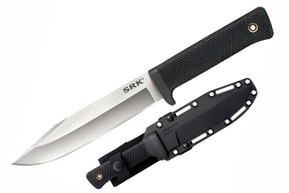
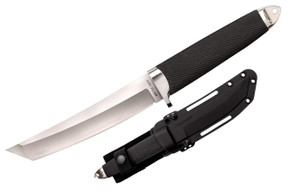
The Recon 1 runs a four inch blade in aggressive peel-ply G-10, built as the hard-use folder in the line. The Code 4 covers the same ground in a slimmer aluminum frame at roughly 4.3 ounces, which is the one that actually disappears in a pocket. Both come in clip point, spear point, and tanto, and the Americanized tanto profile Cold Steel popularized in the 1980s puts extra steel behind the tip for penetration. On fixed blades, checkered Kraton gives up appearance for grip when hands are wet or bloody, which is the trade the Master Hunter and SRK are built around.
Cold Steel knives are made in Taiwan and Japan depending on model and steel. Country of origin is listed on each product page, so check the specific model if it matters to you.
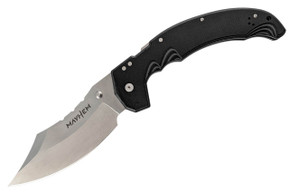
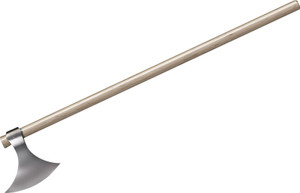
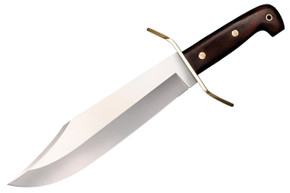
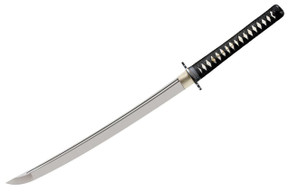
On the folding side, the main Cold Steel folding knives collection sits alongside the Atlas Lock knives, which run a dual-pin mechanism distinct from the Tri-Ad, and the M4-bladed assisted Swift III. Fixed blade depth spans the full Cold Steel fixed blades range plus dedicated collections for hunting knives, the D2 Leatherneck series, the Kobun boot knife, and bowie knives. Cold Steel also remains one of the few production makers still serious about swords, and the Espada carries that scale into a folder. Cold Steel axes and karambit knives round out the catalog.








 Free Shipping Made In USA