
Collections
 Free Shipping
 Made In USA
Reate Knives occupies a position almost nobody else in production cutlery does. Founded in 2014 by David Deng, an engineer by training rather than a bladesmith, Reate built its reputation on tolerances that read as custom work at production volume. The company also machines knives for other brands under contract, which means a fair number of enthusiasts have owned Reate craftsmanship without the name on the blade; boutique builds like the Luft Concepts AVNT come out of Reate's machines by design.
Steel selection runs premium across the catalog. M390 and M398 appear on flagship builds, with Elmax, CPM-3V, S35VN, S90V, Nitro-V, and Damascus distributed across the range depending on model and intent. That spread is deliberate rather than scattershot, since a gravity knife that lives in a pocket and a hard-use flipper want different properties from their steel. Our knife steel comparison guide covers how these alloys behave against one another. Handles are where Reate separates itself further, machining 6AL4V titanium and pairing it with carbon fiber, Micarta, Ultem, zirconium, Zircuti, and mokuti inlays. If those materials are unfamiliar, our handle materials guide explains what each one actually does in hand.
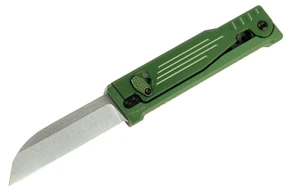
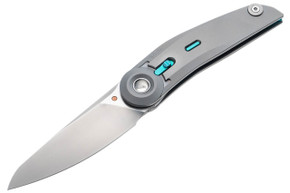
The EXO is the model that pushed Reate from respected to unavoidable. Released in 2021, it revived the gravity knife with a pivoting frame and sliding lock, dropping the blade under its own weight with no spring involved. The line expanded quickly into the EXO Mini, the EXO-M, the karambit-profiled EXO-K, the utility-blade EXO-U, and the push dagger EXO-D. The newest branch is the EXO Performance, which packs two Nitro-V blades into one aluminum frame, a plain stonewashed edge and a fully serrated satin one, so the same knife covers clean cuts and rope work.
The folding catalog is where Deng's engineering background shows most plainly. Ball bearings sit recessed out of the pivot's side profile so debris cannot reach them, and pocket clips are finished on the interior face to keep them from chewing through fabric. The T6000 and T3000 anchor the titanium framelock range, with the rest of the numbered line filling in behind them: the T1000, now into its V2 generation, and the T2500 and T4000, which pair M390 and Damasteel blades with carbon fiber and mokuti inlays. The MagnaCut-bladed Terminator T600 continues that lineage.
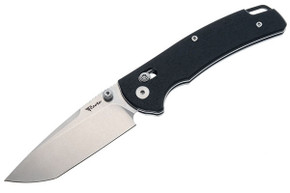
The PL-XT carries the button lock platform at the approachable end of the catalog, and it has grown into a full family. The PL-XF scales the same fidget-friendly button lock up onto aluminum handles, the PL-XE runs G-10 and Micarta, and the PL-6 and PL-7 round out the line in Ultem and Micarta with Nitro-V blades.
Collaborations with Todd Begg, Tashi Bharucha, and Kirby Lambert bring custom design language into production runs; the T3500 is a Bharucha design, a 3.5 inch flipper riding ceramic ball bearings. The Vulpex VK series, designed with Steven Kempa of Vulpex Knives, runs four models deep: the VK-TRON, a non-locking double detent folder with adjustable tension, plus the VK-ANUB, VK-CLU, and VK-FROK in Elmax. The TF-4 remains one of the more configuration-rich models in the lineup.
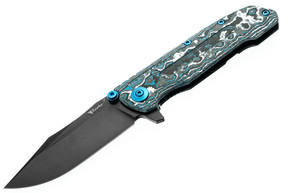
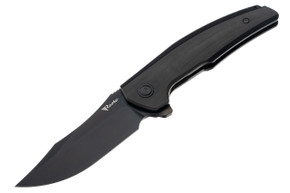
Past the numbered lines, the catalog scatters into distinct one-offs. The Bushido works a Japanese-influenced profile, the 9D-V2 carries the District 9 series into its second generation on FatCarbon, and the Horizon X moves the brand onto a crossbar lock with dual thumb studs. The dress end of the catalog runs through the front-flipper Tribute with its zirconium and mokuti bolsters, the GTR with zirconium inlays over hand satin M390, the Elmax-bladed Mantis and Remedy, the titanium Gents #9 framelock, and the Velocity in anodized and bead blasted titanium. The Jack, stocked in its carbon-inlaid Jack Jr. form, and the M390 Zoro complete the roster.











 Free Shipping Made In USA